
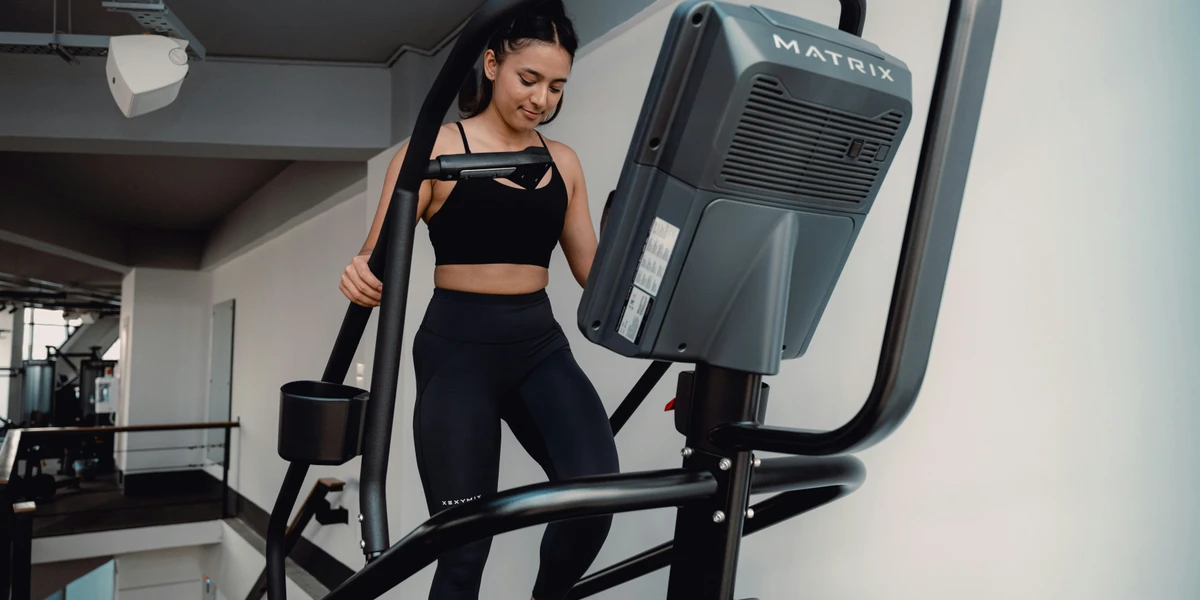
If your goal is to build muscle, you may have heard that cardio is something you should avoid.
The idea sounds simple:
- Lift weights → build muscle.
- Do cardio → lose muscle.
But the reality is much more complicated.
For most people, adding a sensible amount of cardio to a strength training program is unlikely to stop you from gaining muscle. In fact, combining resistance training with cardiovascular exercise can be a very useful approach for improving overall fitness and health.
The key is understanding how much cardio you are doing, how hard you are doing it, and whether you are recovering and eating enough to support your training.
Walking isn’t going to kill your gains
Let’s start with one of the simplest forms of cardio: walking.
Walking 10,000 steps a day is not going to suddenly interfere with your ability to build muscle.
The same applies to shorter, higher intensity sessions. A few 15 to 20 minute HIIT sessions each week can be incorporated into a training program without automatically compromising muscle growth.
For most recreational lifters, there is no reason to avoid cardio simply because they are trying to gain muscle.
The bigger concern comes when cardio becomes excessive.
When can cardio become a problem?
The problem isn’t necessarily cardio itself.
It is the combination of high training demands and limited recovery resources.
Imagine someone is lifting weights several times a week while also doing large amounts of endurance training. Their total energy expenditure can become very high.
If they are not eating enough to replace the energy they are using, there may simply not be enough energy available to support all of their training and recovery demands.
This becomes particularly relevant for people who are trying to maximise muscle growth or prepare for bodybuilding competitions.
A long endurance session occasionally isn’t going to destroy your muscle.
But regularly combining high volumes of endurance training with high volumes of resistance training can make it much harder to recover and maximise your results.
Your goal matters
There is an important difference between being fit and trying to maximise a particular adaptation.
If you’re a recreational lifter who wants to build some muscle, get stronger, improve your cardiovascular fitness and stay healthy, you don’t need to choose between weights and cardio.
You can do both.
Competitive athletes have been doing this for years.
Team sports such as basketball and ice hockey require athletes to be strong and powerful while also having good aerobic fitness. Their training therefore has to develop multiple qualities at the same time.
The goal isn’t to eliminate one type of training.
It’s to organise the training so that the different demands don’t unnecessarily interfere with each other.
Can you do cardio and weights on the same day?
Sometimes you don’t have a choice.
Maybe you have a busy schedule and only have 45 minutes at the gym.
You might have 20 minutes available for cardio and 20 minutes for resistance training.
In that situation, something is better than doing nothing.
However, if strength or muscle growth is your priority, the general recommendation from the discussion is to perform your resistance training first.
Why?
Because high-intensity cardio, particularly HIIT, can take a significant amount of energy out of you.
If you perform a hard cardio session first, you may not have the same energy or performance available when you get to your weights.
And when building muscle is the priority, you want to be able to train your muscles hard and effectively.
So if you have to do both in the same session:
Weights first. Cardio second.
What about circuit training?
Circuit-style weight training is an interesting middle ground.
Instead of completing a set, resting for several minutes and then moving to the next exercise, you move relatively quickly between exercises.
This keeps your heart rate elevated and can provide a cardiovascular stimulus as well as resistance training.
Research discussed in the transcript suggests that circuit training can improve cardiorespiratory fitness and contribute to fat loss, although the effects are not necessarily as pronounced as with dedicated aerobic training.
However, there is a potential trade-off.
If you’re trying to maximise muscle growth and you’re taking your sets relatively close to failure, moving quickly through a long circuit can create a lot of fatigue.
By the time you reach the later exercises, you may not be able to perform those sets with the same level of effort and quality.
For someone whose primary goal is maximising hypertrophy, traditional resistance training with appropriate rest periods is likely to make more sense.
Separate your cardio and weights when possible
If your schedule allows it, another option is to separate your cardio and resistance training.
For example:
- Monday: Resistance training
- Tuesday: Cardio
- Wednesday: Resistance training
- Thursday: Cardio
- Friday: Resistance training
This gives you dedicated sessions for each type of training rather than trying to cram everything into one workout.
The discussion also highlights the idea of separating the sessions by time when both need to happen on the same day.
This can help you give each type of training more attention without unnecessarily compromising the quality of the other session.
Don’t forget to eat
One of the biggest issues with combining a lot of cardio and strength training isn’t necessarily the cardio itself.
It’s energy availability.
If you’re burning a large amount of energy through training but aren’t eating enough to support your activity, gaining muscle becomes much more difficult.
This is particularly important if you’re trying to gain weight or maximise muscle growth.
Your body has to deal with all of the demands placed upon it: training, recovery and normal physiological functions.
So if you’re doing a huge amount of cardio while also trying to gain muscle, make sure your nutrition is keeping up with your activity.
Bottom line
The bottom line is that cardio does not automatically stop muscle growth, and moderate activities like walking or sensible amounts of cardiovascular exercise can easily be combined with strength training. However, excessive endurance training can hinder recovery and muscle growth, making nutrition and total energy intake increasingly important as overall training volume rises. To optimize your results, prioritize lifting before cardio when strength or hypertrophy is your primary goal, and keep in mind that while circuit training offers both resistance and cardiovascular benefits, it may not be ideal for maximizing pure muscle growth.
Resources
▶Brad Schoenfeld’s Top 5 Strength Myths BUSTED!(26.33 min) | Real Exercise Science
▶Brad Schoenfeld’s Top 5 Strength Myths BUSTED! - Instagram Short | Real Exercise Science