
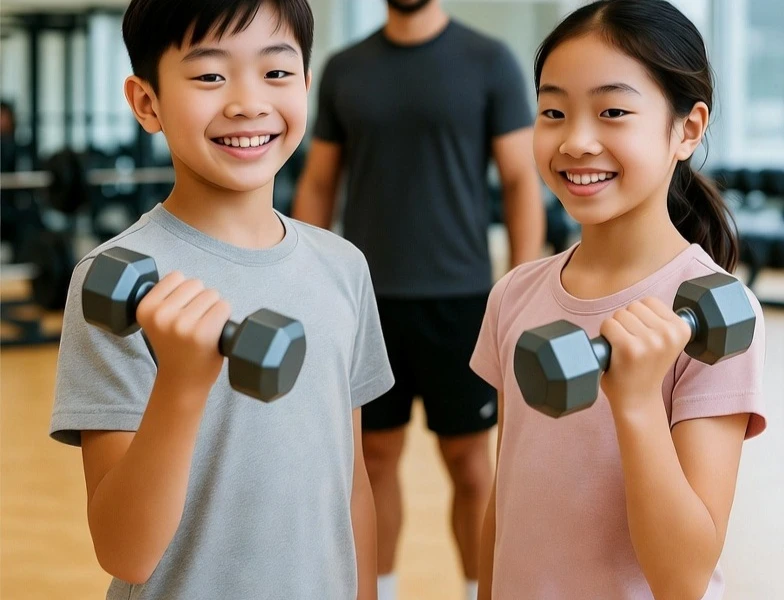
For decades, parents have been warned that lifting weights is dangerous for children. “You’ll stunt their growth.” “It’ll damage their joints.” “They’re too young for strength training.”
The problem? Most of these fears are based on outdated myths — not modern evidence.
Today, a large body of research shows that properly supervised resistance training is not only safe for children and adolescents, but can provide significant physical and psychological benefits.
The Myth That Won’t Die: “Weights Stunt Growth” This is probably the biggest concern parents have when they hear the words “kids” and “weights” in the same sentence. But research does not support the idea that resistance training stunts growth.
Growth in children occurs at the growth plates near the ends of long bones. Injuries to these growth plates can happen, but they are rare in supervised strength training programs and are far more commonly seen in contact sports, collisions, falls, and poorly supervised activity.
In fact, many sports parents worry about a child doing deadlifts or squats in a gym while happily signing them up for activities like football, gymnastics, skateboarding, or motocross — all of which typically carry a much higher injury risk.
The issue is not strength training itself. The issue is poor supervision, excessive loading, bad technique, or inappropriate programming.
What the Research Actually Shows
When done correctly with good coaching, youth strength training delivers impressive benefits:
- Better Strength & Athletic Performance Kids become stronger, more coordinated, and move more powerfully. This improves their running, jumping, sprinting, and overall sports performance. Most early strength gains come from better brain-muscle connection, not big muscles.
- Stronger Bones Resistance training during childhood and adolescence helps build bone density. Since peak bone mass is mostly developed by late teens, this creates a strong foundation that can protect against fractures and osteoporosis later in life.
- Improved Movement Skills Kids learn fundamental movements: squatting, jumping, landing, pushing, and pulling. This builds “physical literacy” — the confidence and ability to move well for life.
- Greater Confidence & Mental Health One of the most powerful benefits is psychological. Kids feel capable, resilient, and proud of what their body can do. This is especially valuable for girls, who often receive messages to be smaller or less physical. Teaching girls to be strong helps them grow into confident women.
- Lifelong Fitness Children who enjoy movement and feel competent at it are far more likely to stay active as adults. This helps fight obesity, heart disease, and poor mental health.
So What Should Youth Strength Training Actually Look Like?
What Good Youth Strength Training Looks Like It’s not about putting a 10-year-old under a heavy barbell and making them lift maximum weights. Good programs focus on:
- Proper technique first
- Gradual progression
- Qualified coaching and supervision
- Age-appropriate exercises
- Making it fun
For younger kids, this often means:
- Bodyweight exercises
- Resistance bands
- Medicine balls
- Jumping, climbing, and playing
As children get older and show good movement control, they can gradually add more weight. The goal isn’t to create bodybuilders. The goal is to build strong, confident, capable kids who enjoy moving their bodies.
The Bigger Picture
Modern kids are often less physically active than previous generations. Screen time is up, movement is down, and rates of inactivity and obesity continue to rise.
Strength training is not something to fear.
When taught properly, it can help kids become:
- stronger
- more resilient
- more coordinated
- more confident
- healthier for life
Instead of teaching children to fear lifting weights, we should focus on teaching them how to move well, train safely, and develop confidence in their bodies.
Because strength is not dangerous.
Weakness and inactivity are far bigger problems.
Resources:
▶Will lifting weights stunt a child’s growth? | Peter Attia and Belinda Beck PHD | Layne Norton
▶Should This a 9 Year Old Girl Be Deadlifting? | Layne Norton