
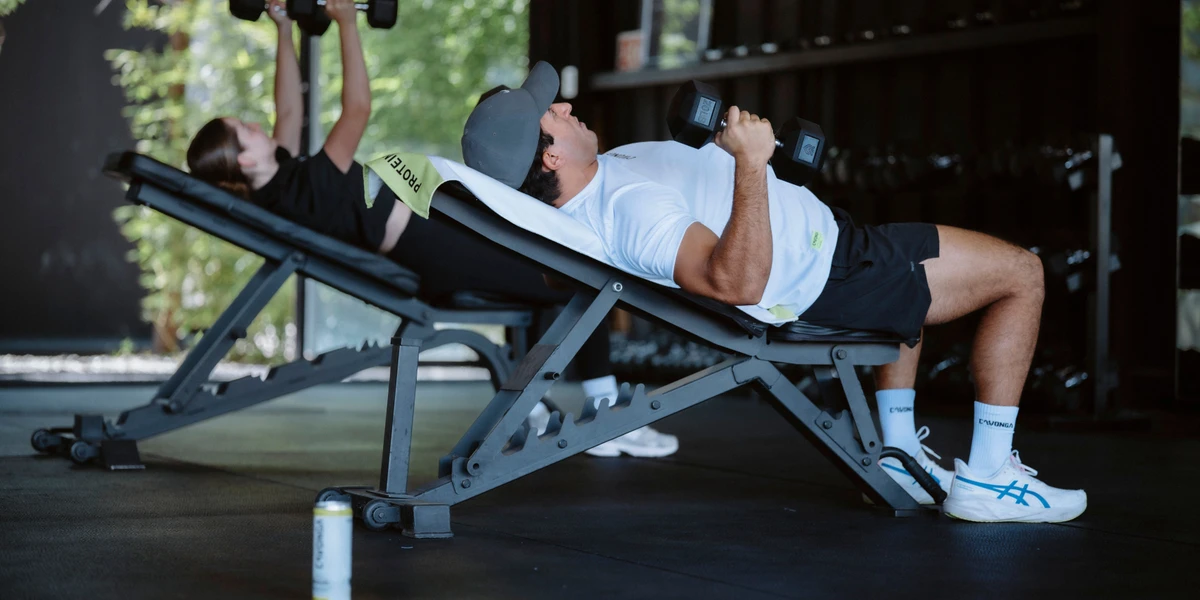
For most people, most of the time, the sweet spot is a slight tuck: elbows roughly 45 degrees from your body. That goes for the barbell bench press, dumbbell press and push-ups alike.
Why does such a small detail matter? Because where your elbows point changes which muscles do the work, how strong you are, and how happy your shoulders feel. Here’s the simple version.
The three ways to place your elbows
Picture yourself from above, mid-rep. Your elbows can sit in one of three places:
- Flared (about 90 degrees): elbows straight out to the sides, making a “T” shape with your body. Purpose: mostly used by bodybuilders to get extra stretch through the pecs and front of the shoulders.
- Fully tucked (close to 0 degrees): elbows pinned against your ribs. Purpose: shifts the focus onto the triceps, as in a close-grip bench press, and takes load off the chest.
- Slightly tucked (about 45 degrees): in between. Seen from above, your body and arms make an arrow shape, not a “T”. Purpose: everyday strength training and powerlifting, sharing the work across chest, shoulders and triceps so you can lift the most.
Each has a purpose. But for everyday training, the arrow wins.
Reason 1: Your shoulders
Inside your shoulder, a tendon (the supraspinatus, part of your rotator cuff) runs through a narrow gap. That gap sits between the top of your upper arm bone and a bony ledge of your shoulder blade.
When you flare your elbows out to 90 degrees, that gap can get smaller for some people. Bone can then pinch or rub the tendon. This is called impingement, and it’s a common cause of that nagging “front of shoulder” pain from pressing.
The good news: it isn’t guaranteed. In a healthy shoulder, the shoulder blade moves to keep that space open. So flaring isn’t automatically dangerous. But if your shoulders complain when you press, bringing the elbows in a little is the first thing to try.
Reason 2: You’ll be stronger
Muscles have a strength “sweet spot”. They’re strongest at mid-length, and weakest when fully stretched or fully shortened. Coaches call this the length-tension relationship.
Your elbow angle sets the length of your chest muscles at the bottom of the rep:
- Flared: chest is fully stretched, so it’s in a weak position.
- Fully tucked: chest does less of the work, and your triceps and shoulders can’t make up for it.
- Slightly tucked: chest sits near mid-range, and the load is shared between chest, shoulders and triceps.
Pressing isn’t just a chest exercise. The more muscles share the work, the more you can lift. That’s why powerlifters press with a moderate tuck.
When to break the rule
Flare a bit more to build your chest. Muscles tend to grow best when trained in a stretched position. Flaring puts the chest under a bigger stretch, which is why bodybuilders often use it. Guillotine presses and wide dumbbell presses are examples. Go lighter, as you’re weaker in this position, and skip it if your shoulders object.
Tuck all the way to spare your chest. Coming back from a pec strain or tear? A close grip with elbows tucked tight shifts the work to your triceps and shoulders. It’s a useful way to keep pressing while the chest recovers. Check in with your physio first.
How to do it
- Barbell bench press: grip just outside shoulder width. Bring the bar down to your lower chest, letting elbows travel to about 45 degrees. Don’t pin them to your sides.
- Dumbbell press: same 45-degree path. Dumbbells let your wrists turn freely, so find the angle that feels smooth on your shoulders.
- Push-ups: hands just outside shoulder width. As you lower, think “arrow, not T”. Elbows angle back toward your hips, not straight out.
The takeaway
Keep your elbows at roughly 45 degrees for most of your pressing. It shares the load across your chest, shoulders and triceps, puts you in your strongest position, and is kinder to your shoulders. Flare more for extra chest stretch; tuck tight to protect an injured pec. And remember that 45 degrees is a starting point. Small tweaks to suit your body are normal.